
135
Industrial operations have entered a phase where physical machinery and digital intelligence can no longer exist in silos. For decades, the primary medium for delivering technical data to plant personnel was static: printed manuals, laminated schematics, and desktop terminals positioned away from the assembly line. Even the transition to ruggedized tablets still forced technicians to split their focus between a two-dimensional screen and three-dimensional machinery.
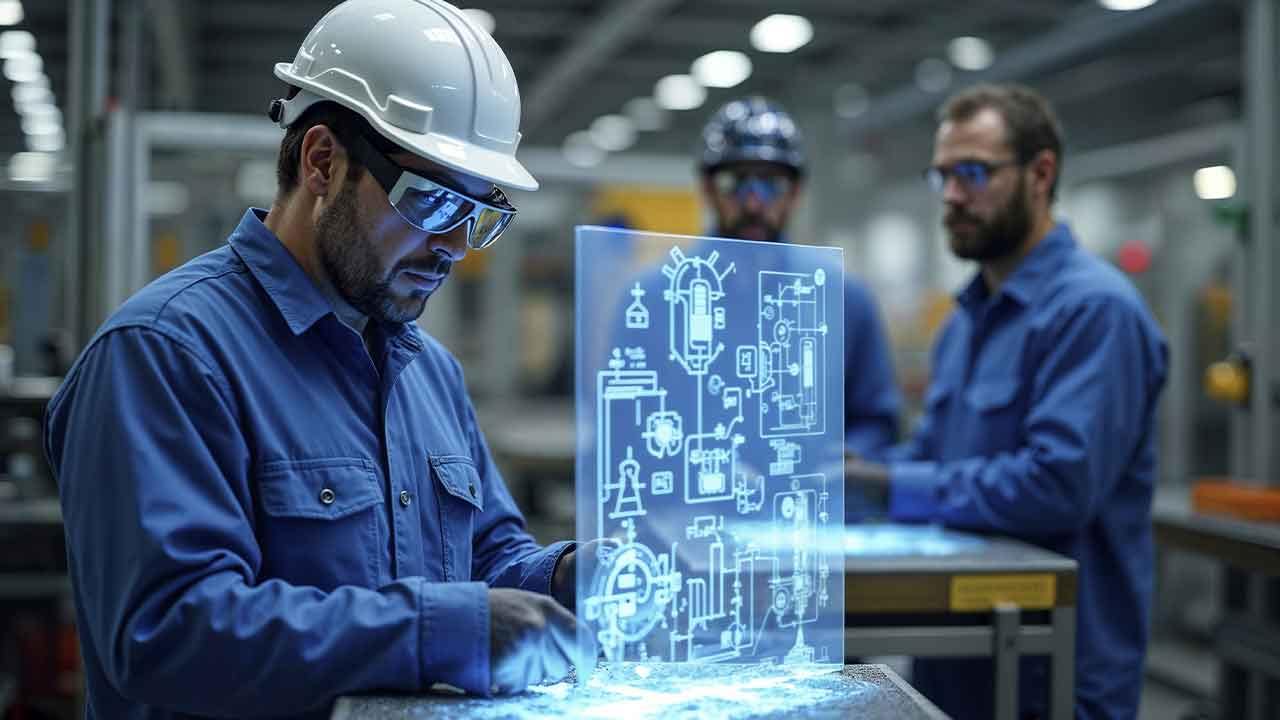
Augmented reality fundamentally alters this interaction. By projecting digital information directly onto physical assets in real time, spatial computing bridges the cognitive gap between information retrieval and mechanical execution. From high-tolerance aerospace manufacturing to complex refinery maintenance, industrial enterprises are deploying AR to accelerate production cycles, compress training curves, and reduce costly human errors.
The Cognitive Shift from Flat Screens to Spatial Context
The core advantage of augmented reality on the shop floor lies in contextual placement. When technicians consult paper binders or tablets, they experience what cognitive psychologists call the split-attention effect. The human brain must read a two-dimensional diagram, mentally translate those schematics into a three-dimensional space, locate the physical component, and then execute the work.
Spatial computing removes this mental translation step. By anchoring animated instructions, wiring paths, and torque specifications directly onto the physical workpiece, the worker maintains constant visual contact with the machine.
-
Continuous focus: Hands-free smart glasses keep technicians focused on physical tooling rather than navigating software interfaces.
-
Contextual alignment: 3D digital overlays map precisely to sub-assemblies, highlighting the exact fastener, valve, or circuit board requiring intervention.
-
Reduced mental fatigue: Eliminating the need to reference external documents lowers cognitive burden and improves overall alertness across long shifts.
Assembly and Manufacturing: Precision Through Real-Time Guidance
Modern discrete manufacturing frequently requires assembling thousands of individual components under tight tolerances. In industries such as automotive, defense, and heavy machinery, minor errors in assembly can trigger cascading quality defects, line shutdowns, or safety hazards.
AR transforms complex assembly lines into self-guiding workflows. By linking Computer-Aided Design models with spatial tracking, AR headsets project interactive overlays that guide assemblers through every sequence.
-
Dynamic cable routing and wiring: In aerospace and automotive harnesses, AR projects the exact path wires must follow through an airframe or chassis, eliminating guesswork in dense mechanical bays.
-
Tool telemetry integration: Smart torque wrenches connected to AR systems highlight the target bolt in the technician field of view, verify applied foot-pounds in real time, and illuminate green only when the fastener reaches exact specifications.
-
Poka-yoke validation: Built-in computer vision algorithms inspect each completed step before allowing the worker to proceed, integrating error-proofing directly into the assembly process.
This real-time feedback loop dramatically reduces assembly defects while allowing manufacturers to handle high-mix, low-volume production runs without requiring months of line retraining.
Maintenance, Repair, and Operations: Dynamic Telemetry and Diagnostics
Equipment downtime in capital-intensive industries often costs tens of thousands of dollars per minute. When unexpected breakdowns occur, diagnostic speed is critical. Traditional troubleshooting often requires technicians to open panels, measure voltages with handheld meters, and flip through troubleshooting flowcharts.
Integrating augmented reality with Industrial Internet of Things platforms, Supervisory Control and Data Acquisition systems, and digital twins changes this paradigm completely.
When a maintenance technician approaches a pump or turbine wearing an AR device, the system automatically recognizes the machine via spatial anchors or barcode identifiers. The technician sees live performance metrics floating above the equipment, including operating temperature, vibration harmonics, pressure gradients, and historical maintenance logs.
If an anomaly occurs, the AR system highlights the internal component responsible for the failure without requiring physical teardown. For field service technicians operating in remote environments, remote-assist capabilities allow senior engineers thousands of miles away to view live video feeds and draw 3D annotations in the technician field of view, solving complex mechanical failures on the first attempt.
Overcoming the Knowledge Drain: Rapid Upskilling and Mentorship
The manufacturing sector faces an accelerating demographic challenge as veteran technicians and engineers reach retirement age. Decades of institutional knowledge and undocumented troubleshooting instincts risk disappearing with them.
Augmented reality serves as an automated capture mechanism for institutional knowledge:
-
Workflow recording: Experienced operators wear AR headsets to document complex changeovers or overhaul procedures. The system captures spatial coordinates, hand gestures, and spoken commentary.
-
Automated standard operating procedures: Captured footage transforms into interactive, step-by-step 3D modules that junior workers can follow independently.
-
Accelerated time to proficiency: New hires learn directly on physical equipment using digital overlays, cutting training times down from months to weeks.
By turning subjective expertise into structured digital assets, industrial organizations build resilience against workforce turnover.
Quality Assurance: Real-Time Verification and Defect Prevention
Traditional quality control often relies on batch inspections conducted after parts exit the production line. If a manufacturing defect occurs early in the process, dozens of defective units may be assembled before the fault is detected.
AR shifts quality management from retrospective inspection to real-time verification. Quality control engineers utilize spatial overlays to compare the physical part directly against its original CAD blueprint.
-
Deviation mapping: The system highlights tolerance variations in color-coded heatmaps directly across the component surface, showing where metal has been milled too thin or where panel gaps exceed design limits.
-
Automated visual audits: High-resolution cameras on smart headsets scan weld seams, sealant beads, and fastener presence, instantly logging photographic proof of compliance into Manufacturing Execution Systems.
-
Auditing traceability: Every measurement and visual verification is recorded alongside a timestamp and technician ID, creating an immutable audit trail for regulatory compliance.
Logistics and Warehousing: Hands-Free Vision Picking
Supply chain facilities and fulfillment centers require rapid, accurate sorting and picking to maintain operational tempo. While handheld barcode scanners improved tracking over paper manifests, they keep one of the worker hands occupied.
Vision picking via AR smart glasses streamlines warehouse logistics:
-
Optimized path navigation: The AR display projects navigational arrows on the warehouse floor, guiding pickers along the shortest route through racking aisles.
-
Optical barcode scanning: Onboard cameras scan barcodes and QR codes automatically as the worker looks at the bin, validating the pick without manual scanning.
-
Visual bin verification: The headset highlights the exact shelf partition containing the requested item and displays the target quantity in the user visual field.
This hands-free approach accelerates order fulfillment speeds while reducing picking errors to near-zero levels.
Technical and Operational Challenges to Enterprise Adoption
While the operational benefits of augmented reality are substantial, scaling AR from pilot projects to full production environments requires solving specific technical and organizational challenges.
-
Hardware ergonomics: Extended shifts require headsets that balance battery longevity, thermal management, and physical weight to prevent neck strain or discomfort.
-
IT and OT integration: Deploying AR across an enterprise requires seamless data pipelines between spatial computing software and legacy Enterprise Resource Planning, Product Lifecycle Management, and MES architectures.
-
Network latency and bandwidth: High-fidelity 3D model streaming and live video diagnostics require robust wireless infrastructure, often accelerating the deployment of private industrial 5G networks and edge computing clusters.
-
Environmental durability: Industrial environments demand ruggedized hardware capable of withstanding extreme temperatures, dust ingress, moisture, and accidental drops.
As enterprise software ecosystems mature and spatial hardware becomes lighter and more rugged, AR is shifting from an experimental novelty into an indispensable component of modern industrial infrastructure.
Frequently Asked Questions
What is the difference between optical see-through and video see-through headsets in industrial environments?
Optical see-through displays project digital graphics onto transparent lenses, allowing workers to maintain direct, unmediated visual contact with their physical surroundings. Video see-through systems use external cameras to capture the real world and display the combined camera feed and digital assets onto internal screens. For heavy manufacturing and hazardous shop floors, optical see-through is generally preferred because it eliminates the risk of complete visual blackout if the device experiences a battery failure or software crash.
How do intrinsically safe AR devices differ from standard commercial headsets?
Intrinsically safe AR devices are engineered and certified under standards like ATEX and IECEx to operate in hazardous, explosive atmospheres such as oil refineries, chemical plants, and grain silos. These devices are built to prevent electrical sparks, limit surface heat dissipation, and use specialized sealed enclosures that eliminate the possibility of igniting airborne gases, vapors, or combustible dust.
How do industrial facilities handle data security when deploying camera-enabled AR headsets in confidential zones?
Enterprises manage security risks through localized edge processing, air-gapped private wireless networks, and centralized Mobile Device Management software. Many platforms feature geographic fencing that automatically disables camera sensors, spatial mapping, and external recording functions when an employee enters restricted research, development, or defense-classified plant areas.
What strategies mitigate eye strain and visual fatigue for workers using AR over full shifts?
To minimize optical strain, modern industrial AR solutions utilize monocular micro-displays that position data outside the direct line of sight or leverage binocular displays calibrated to natural focal resting distances. Software developers also employ dark-mode user interfaces, high-contrast monochrome palettes, and task-specific triggers that only display digital content when an action is active, leaving the field of view unobstructed during routine handling.
How do industrial AR platforms maintain tracking stability around moving reflective machinery or shifting lighting?
Industrial AR platforms combine visual Simultaneous Localization and Mapping with inertial measurement units and spatial point-cloud models. When environments feature dynamic lighting, vibrating platforms, or polished metal surfaces that confuse standard optical cameras, systems utilize infrared time-of-flight depth sensors, physical fiducial markers, and spatial mesh anchors to prevent digital overlays from drifting.
Can industrial AR solutions operate reliably in remote facilities without continuous internet access?
Yes. Enterprise AR software suites support offline caching modes where CAD models, diagnostic manuals, and interactive work procedures are stored directly on the local hardware memory. Technicians can complete inspections, assemble complex machinery, and record diagnostic data completely offline, with the device automatically synchronizing logs to the central database once connectivity is re-established.
How does augmented reality integrate with industrial powered exoskeletons?
When paired with wearable robotics, AR functions as the user interface for the mechanical suit. The headset displays real-time telemetry regarding battery levels, joint torque assistance, and load distribution, while also analyzing the worker posture through integrated computer vision to alert them to unsafe lifting angles before musculoskeletal strain occurs.
